Quality inspection.
Across the assembly.
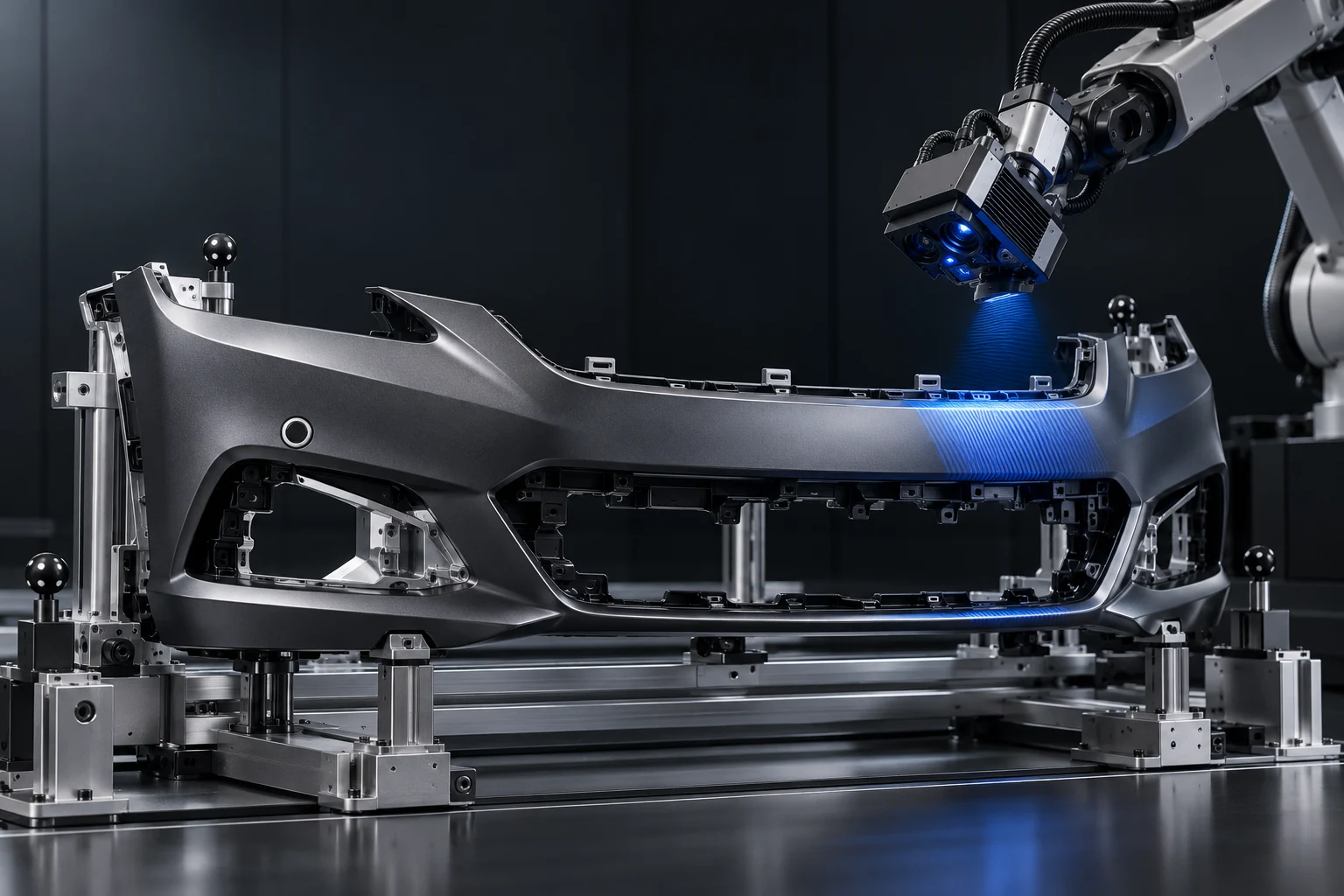
From bumper modules and exterior trim to sensor-equipped and actuated assemblies, connect the required checks to the production process.
Different features.
Different evidence.
Explore the connected checks behind an automotive assembly.
The right part.
In the right place.
Check presence, orientation and visible engagement against the correct product configuration.
- Engineering considerations
- Part identity, fixtures and visibility
- Evidence
- Feature-level results and exception routing
Measure what
actually matters.
Evaluate local position, gap or profile using a measurement method matched to the tolerance and surface.
- Engineering considerations
- Datums, calibration and measurement uncertainty
- Evidence
- Measured values and a defined decision rule
Read the surface.
Understand the context.
Separate relevant surface conditions from acceptable material variation under controlled illumination.
- Engineering considerations
- Defect definitions, boundary samples and lighting
- Evidence
- Localized findings for review or disposition
Appearance is
one part of the answer.
Connect suitable electrical, communication or functional tests when visible assembly alone cannot establish conformity.
- Engineering considerations
- Test access, interfaces and customer specifications
- Evidence
- Linked functional results and test status
A result with
a history.
Associate inspection results with the product, approved recipe and subsequent rework or reinspection.
- Engineering considerations
- Identity, retention rules and controlled versions
- Evidence
- Retrievable product-level quality records
Assembly completeness
and configuration.
Evaluate clips, brackets, inserts, trim, fasteners and variant-specific parts for presence, orientation and visible engagement.
Gap, flush
and installed position.
Measure selected features using an agreed datum, tolerance and validated method. Match the measurement approach to material, access and tolerance.
Mounting geometry
and assembly state.
Check the applicable holder, sensor seating, ring fit, visible obstruction and connector state. Add the required electrical or functional tests within the assembly scope.
Defects under
controlled observation.
Evaluate scratches, contamination and other defined surface conditions against agreed appearance samples and lighting conditions.
Variant verification
and functional checks.
Extend the method to grilles, decorative trim and illuminated features. Introduce electrical, photometric or color measurement methods where specified.
Movement and
test-result integration.
For modules such as active grille shutters, define the required actuation, position, current or communication tests and connect their results to the product record.
Where the station
meets the line.
Inspection is engineered around how the product moves through manufacturing.
In-process verification
Confirm assembly states before the next operation, with production feedback and clear exception handling.
End-of-line inspection
Coordinate final checks, variant verification and release records in a dedicated inspection station.
Rework & reinspection
Link the original finding, correction and subsequent inspection to the same product history.
New programs & line upgrades
Integrate a new station or extend an existing workflow, including plant interfaces and operator handover.
Beyond the exterior.
The same engineering discipline.
Apply the inspection approach to other automotive parts and assemblies.
Assembly detail.
Visible quality.
Part presence, orientation, fit and defined appearance checks for interior modules and trim assemblies.
Part-level checks.
Connected results.
Dimensional and visual verification for molded parts, housings, connectors and electronic assemblies, with functional-test integration where required.
Bumper inspection.
Questions that shape the solution.
Address the physical feature and the production context together.
How are dark sensor rings and low-contrast gaps approached?
Separate the inspection tasks: visible seating and presence, local geometry, and required functional tests. Optical access, illumination and the reference method are evaluated on representative parts before the station configuration is finalized.
How are flexible bumper assemblies positioned for measurement?
The datum, support and clamping concept is matched to the feature being checked. Reloading variation and part deformation are included in the evaluation, so the fixture and measurement method are assessed together.
How is a new product variant introduced?
The product identity selects the relevant recipe and inspection requirements. Tooling, coverage and acceptance are reviewed for the new variant, with configuration records carried into production.
How are inspection findings connected to rework?
The result is associated with the assembly identity. The workflow defines failure routing, the required correction and the relationship between the original finding and subsequent reinspection.
Visible assembly.
Connected functional evidence.
A sensor-equipped module can require checks beyond visible presence and fit.
Installation & test integration
Connect visible seating and orientation checks with the electrical, communication or functional tests specified for the module.
Material & transmission testing
Where the product specification calls for radar-transparency evaluation, coordinate a suitable RF test method and equipment interface with the assembly inspection. The vehicle and component requirement define applicability.